Summary
The RIC Documents are a base reference to study, design, execute, review, operate and maintain electrical consumer installations in Chile. They are not a list to memorize: they are a way to order safety, quality, documentation and commissioning criteria.
This guide summarizes the general map of the RIC and guides your study. For any design, declaration, review or execution, the governing source is always the current official SEC documentation.
What are RIC Documents?
The RIC Regulatory Technical Documents are part of the technical framework associated with the Safety Regulations for Electrical Energy Consumption Facilities. In practical terms, they provide requirements and criteria for a consumer electrical installation to be designed, executed, put into service, operated and maintained under safe conditions.
They help answer very specific questions: how a splice should be resolved, what requirements apply to panels, how feeders are ordered, what criteria govern conductors and conduits, how people are protected against dangerous voltages, what is expected from a grounding or how a commissioning should be supported.
Where to review official documents
The official source to download and review the RIC Documents is the Superintendence of Electricity and Fuels. It is advisable to avoid loose copies, undated summaries or forwarded files, because they may not be current or may not include subsequent modifications.
How to study them without getting lost
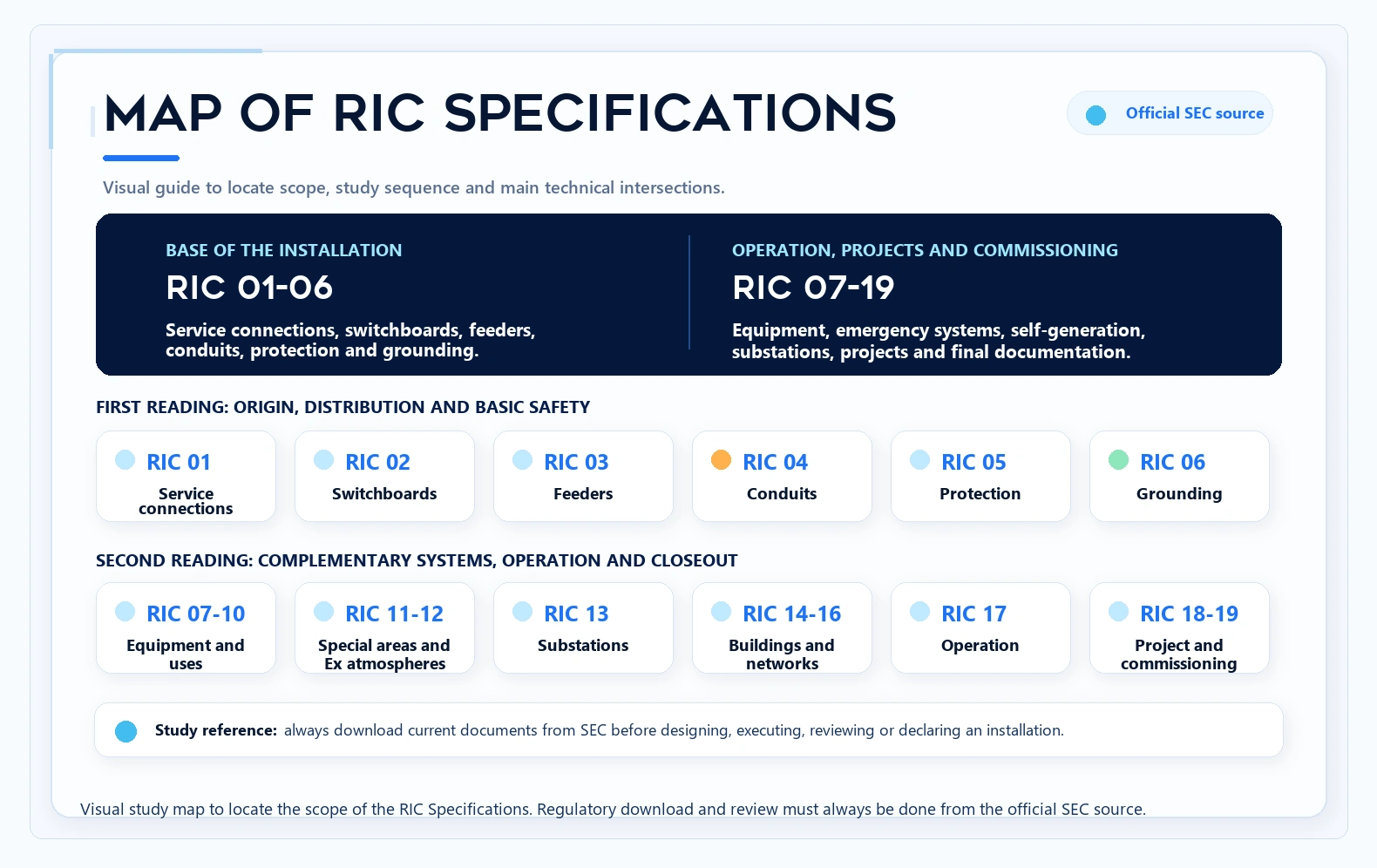
A good way to study RIC is to follow the natural path of a facility. First, the origin of the supply and main distribution are understood: RIC 01, RIC 02 and RIC 03. Then, materials and base safety are reviewed: RIC 04, RIC 05 and RIC 06.
Then it is advisable to move on to equipment, complementary systems and particular conditions: RIC 07 to RIC 16. Finally, operation, maintenance, documentation, project presentation and commissioning are studied: RIC 17, RIC 18 and RIC 19.
Applied example
In an industrial building with an electrical room, general panels, feeders, emergency system, grounding and chargers for electric vehicles, it is not enough to review a single document. RIC 01 could be crossed for splices, RIC 02 for panels, RIC 03 for feeders, RIC 04 for conduits, RIC 05 for personal protection, RIC 06 for grounding, RIC 08 for emergency, RIC 13 for electrical room, RIC 15 for recharging, RIC 18 for project presentation and RIC 19 for commissioning.
This crossing shows something important: RICs are not applied as isolated compartments. In a real project, security, documentation and operation are connected to each other.
Common mistakes when studying RICs
- Read only the document that seems most related and forget about safety crossings, piping, grounding, operation or documentation.
- Believing that RICs are only for installers. They are also relevant for designers, reviewers, maintainers, operators, clients and students.
- Do not review the current version from SEC before working on a real project.
- Memorizing requirements without understanding what technical or security risk each requirement seeks to control.
- Separate engineering regulations: complying with a minimum standard does not replace technical criteria according to criticality, environment, operation, loads and risk.
Why they are important for electrical engineering
The RIC allow establishing a common language among those who design, build, review, maintain and operate electrical installations. They also help protect people, reduce reprocessing, organize documentation, improve technical traceability and reduce risks during commissioning.
In electrical engineering, complying with regulations is the starting point. The next step is to apply professional judgment so that the installation is safe, maintainable, reliable and consistent with actual operation.
Studying the RIC is not just about knowing where each requirement is. Technical value appears when you understand why it exists, what risk it controls, and how it intersects with project design, execution, operation, and documentation.
If you need to apply RIC criteria from the design, review or development of an installation, check out our service. engineering and electrical projects.